
In the world of woodworking, achieving perfect, consistent, and clean holes is what separates amateur projects from professional-grade craftsmanship. This precision is made possible by specialized drill bits, the core components of a woodworker’s arsenal, especially when used in powerful multi-spindle drilling machines known as row drills. These machines, which can feature multiple drill bits working in unison, are fundamental for efficient cabinet, furniture, and fixture making. Understanding the right drill bit for the job not only elevates your work but also protects your tools from premature wear. Let’s explore the four main types that should be in every serious woodworker’s toolkit.


The V-Point Drill Bit: Your Go-To for Speed and Clean Entry
The V-point, or brad point, drill bit is a cornerstone for precision drilling in wood. Its primary design features a sharp, spiked tip at the center, flanked by two sharp spurs that score the wood’s perimeter before the cutting edges engage.
* Main Components: It consists of a central sharp point for accurate positioning, two elevated spurs that cut a clean circle, and radial cutting edges that remove material from within that circle.
* Key Types: They are most commonly found as solid, one-piece high-speed steel (HSS) bits. Premium versions may have carbide-tipped spurs for enhanced durability on abrasive materials like laminated plywood.
* Ideal Applications: This drill bit excels in any scenario where a clean, tear-out-free entry and exit hole is critical. It is the perfect choice for drilling dowel holes, through-holes for bolts, or any decorative boring where the entry point is visible. The sharp point prevents the bit from “walking” or skidding off the intended mark, ensuring perfect hole placement every time.
* Processing Effect: It produces exceptionally smooth-sided, precise holes with minimal splintering on both sides of the workpiece.


The Forstner Drill Bit: The Master of Flat-Bottomed Bores
When the task requires a flat-bottomed hole, a recess, or an overlapping bore, the Forstner drill bit is the undisputed champion. Unlike twist drill bits, it cuts a clean, precise cylindrical pocket.
* Main Components: Its defining features are a flat cutting edge with a short central point for guidance and a circular rim that shears the wood fibers at the hole’s edge.
* Key Types: Forstner bits are typically one-piece tools made from HSS or with carbide cutting edges. Some professional-grade sets feature replaceable blades (insert-type) on the body, allowing you to replace only the worn cutting edge instead of the entire drill bit.
* Ideal Applications: This bit is indispensable for creating hinge recesses, inlaying wood discs, or drilling stopped holes that do not go all the way through the material. It can also drill partial holes at an edge and bore overlapping holes cleanly, which is impossible with standard bits.
* Processing Effect: It delivers impeccably flat-bottomed holes with smooth, vertical sides, offering superior control over depth and a clean finish even on end grain.

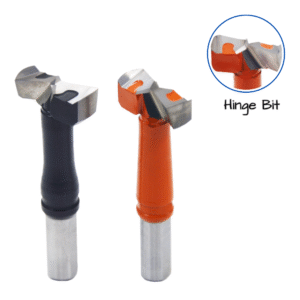

The Countersink Drill Bit: For Seamless, Flush Fasteners
The primary goal of a countersink drill bit is to create a conical recess that allows a screw head to sit perfectly flush with or just below the wood surface. Many models combine drilling and countersinking into one efficient operation.
* Main Components: The most common type is a combination bit, which features a standard twist drill bit for the pilot hole, coupled with a flared cutting cone for the countersink recess. Some advanced versions include a separate counterbore section for fitting a wood plug.
* Key Types: They come as single-piece combination bits or as modular systems where different-sized pilot drill bits attach to a common countersink body. The cutting cone can be a single flute or have multiple flutes for a smoother finish.
* Ideal Applications: This is the essential tool for any joinery involving screws where a professional, finished look is desired. It is used extensively in assembling face frames, installing hardware, and any project where screw heads must be concealed.
* Processing Effect: It creates a pilot hole, a shank clearance hole, and a tapered recess in one step, ensuring screws drive in straight and sit perfectly flush, ready for putty or a wood plug.

The Blind or Dowel Drill Bit: The Hidden Hero of Strong Joints
A blind hole, as the name implies, does not go through the material. The drill bit designed for this purpose is crucial for creating strong, invisible joints, most commonly for dowels.
* Main Components: A specialized blind hole drill bit often has a short flute and a solid tip to help eject chips upward and out of the hole. Many feature a built-in depth stop collar to ensure consistent hole depth, which is critical for successful hidden joinery.
* Key Types: They are generally solid, one-piece bits, often with a brad-point tip for clean entry. Some systems are designed specifically for machine-use in automated row drills, where multiple bits create a series of perfectly aligned dowel holes in seconds.
* Ideal Applications: This bit is the backbone of dowel joinery, used in assembling cabinets, chairs, tables, and any project where a strong, invisible mechanical joint is preferred over visible screws or brackets.
* Processing Effect: It produces a clean, consistent-depth hole at the bottom of which glue can pool, creating maximum strength for a dowel joint without any visible holes on the exterior of the workpiece.


Smart Maintenance to Extend Your Drill Bit’s Life
Proper care is what makes the difference between a drill bit that lasts for years and one that dulls after a few projects. The same discipline applies to maintaining the powerful row drill machines that often house these bits.
During and After Use:
Always ensure the bit is sharp and suitable for the material. Forcing a dull drill bit generates excessive heat, the primary enemy of tool steel temper. When using a row drill, prevent chips and dust from entering the machine’s moving parts, as debris is a major cause of wear. After drilling, clean the flutes of the bit with a brush to remove packed wood resin and dust.
Routine Care and Machine Upkeep:
Store your bits organized in a case or rack to prevent them from knocking against each other. For row drill machines, establish a weekly cleaning ritual. This includes wiping down the machine table, but most importantly, cleaning the guide rails and lead screws and applying a light machine oil. The lead screw is critical for precision, and keeping it free of debris maintains the machine’s accuracy. 또한, regularly check and clean the air filters and drainage in the machine’s pneumatic system to ensure consistent pressure and operation.
By choosing the correct drill bit for your task and committing to simple, consistent maintenance, you invest directly in the quality of your work and the longevity of your tools. This knowledge empowers you to tackle any woodworking project with confidence and professional results.